Westcott Rifle Range and the Rifle Range Halt
Reproduced with acknowledgement to the Westcott Local History Group (2007).
In June 1915 the South Eastern and Chatham Railway Company completed the construction of a small station almost midway between Dorking and Gomshall. It had two 400-foot platforms, 9 to 12 feet wide, with ramps and fenced approaches, and was located just west of the tunnel serving the footpath leading from Coomb Farm to Ranmore. It was partially destroyed by fire in 1928 and never rebuilt. There is no sign of its existence today, nor did its existence have any effect on the development of Westcott. It was too far from the village and, in any event, the railway stop was exclusively for use by soldiers and was known as the Westcott Rifle Range Halt.
A range had existed in the locality since at least November 1889, when the Rt Hon G Cubitt (later the first Lord Ashcombe) signed an agreement with Captain Harman Young, Officer Commanding ‘G’ Company 2nd Volunteer Battalion (Queen’s) Royal West Surrey Regiment, permitting targets to be set up in part of a field on the Denbies Estate near Landbarn Farm, with firing points established at a distance of 100, 200 and 300 yards.
The plan accompanying the agreement indicated the location, and the detail (less the 100-yard marker) was subsequently included, as reproduced below, on the 1891 Ordnance Survey 25-inch map (XXXIII 3).
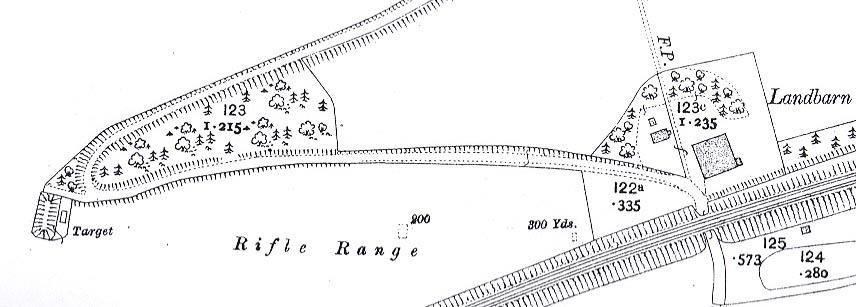
The agreement restricted shooting to just one day between the 1st November and 1st March, and on Mondays, Wednesdays and Saturdays from 2pm until sunset, plus one whole day mutually agreed upon between 1st April and 30th October. The agreed rent for this use was one shilling per year.
The ‘New’ War Office Range
In 1909 the agreement was amended to apply to the new Surrey Territorial Force Association, but a few years later, following increased use before and during the Great War and the introduction of more powerful weaponry, the Landbarn range was abandoned. It was replaced in 1916 by a much larger ‘War Office’ range occupying almost 50 acres. This was constructed a few hundred yards to the west, much closer to the new Rifle Range Halt. The butts were built against the scarp slope of the North Downs and supported at least nine targets, as illustrated below.
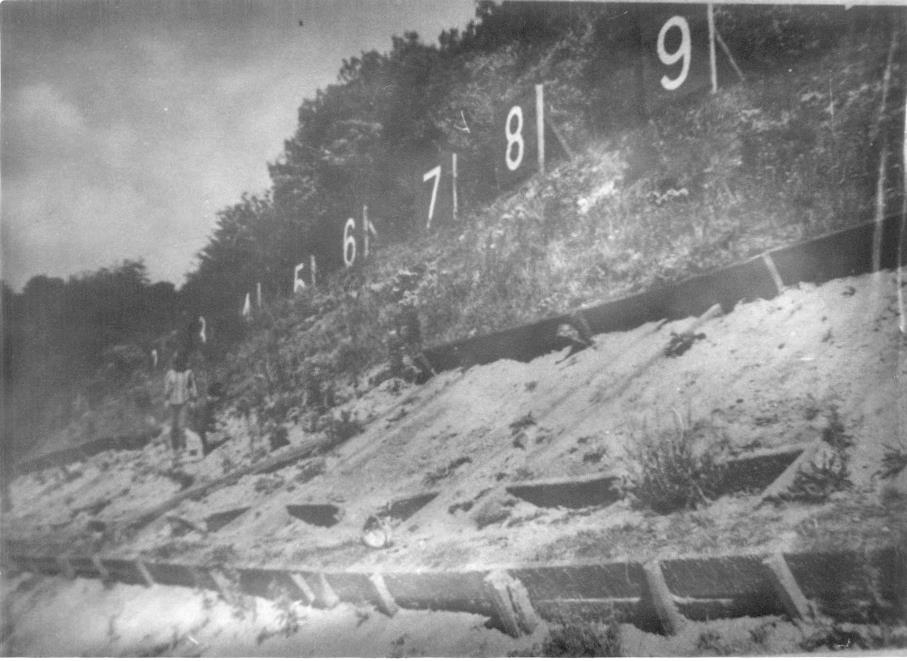
In the post-war years the range, and the nearby Halt, continued to be used. In April 1922, for example, the Dorking Advertiser reported that 300 officers and men of the East Surreys 5th Battalion spent a day firing at the Westcott Range. These were territorials, but with the approach of the Second World War the range was also used by regular troops, and during the war by the Home Guard.
After the war, national servicemen and cadets practised at the Westcott Range, and in July 1948 the War Office proposed a significant extension, embracing much of Ranmore Common, to create a military training area of nearly 900 acres. The local Planning Officer objected on the grounds that the land formed part of the North Downs Preservation Scheme, and the proposal was withdrawn, as was an amended scheme submitted a year later that involved 320 acres.
Although isolated, the noise generated by the range evidently travelled across the Holmesdale Valley, especially when machine gun training was introduced in October 1954. Mr J Moody of Stowe Cottage in Balchins Lane, Westcott, protested to the local authority, but the Clerk to Dorking Council was able to reply that the matter was out of his hands: “The rifle range is in War Department occupation and is outside town planning control.”
Decline and Closure
New butts and a range warden’s workshop were constructed between 1956 and 1959, accompanied by new byelaws requiring a sufficiency of warning signals — specifically ‘Firing in Progress’ notices — to give adequate warning when the area was closed to the public.
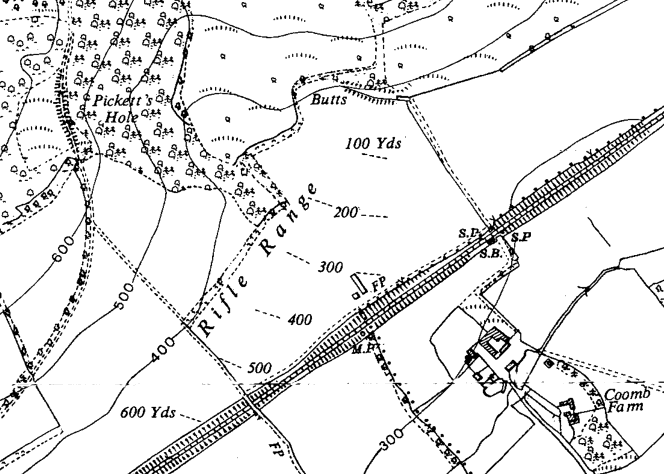
However, the use of the new facilities was short-lived. Problems arose when the ‘stop butt’, cut into the side of the hill, started to slip, and then the concrete and brick mantlet crumbled so badly that a ‘low shot’ bullet actually went through and caused a slight injury to one of the target markers. In light of this evidence, the cessation of National Service, the proximity of a public footpath, and the fact that long-range events required firing across the railway line, the War Office decided that the range was no longer required. It closed in June 1962, and cattle from Coomb Farm were permitted to return to grazing from which they had been displaced 50 years earlier. The butts remained in place for many years afterward, though much of the brickwork had collapsed — the remaining features were finally demolished in September 2007 by local landowner Lawrence Matthews after the site was deemed a health and safety hazard.
The Westcott Rifle Club and the Westcott Cup
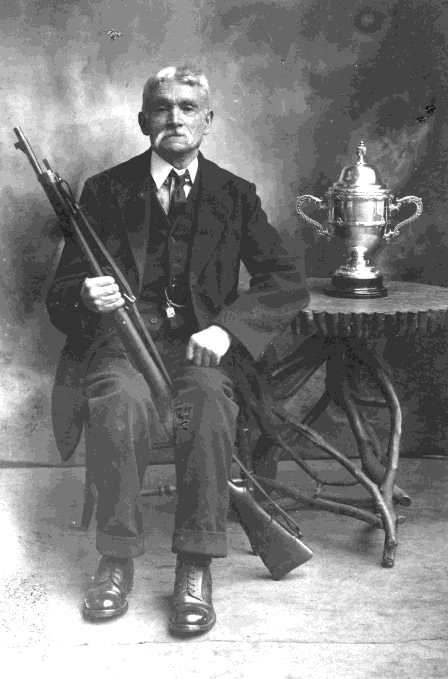
In addition to military use, the range was used by the Westcott Rifle Club, and from 1954 until 1958 (excepting 1956, when the range was closed for repair) it was the venue for teams from other Surrey rifle clubs competing for the Westcott Cup. That competition continues to be held each year, organised by the Surrey Rifle Association, though the venue is now the National Rifle Association ranges at Bisley.
The ranges close to Landbarn and Coomb Farms should not be confused with the much smaller 25-yard range constructed on land provided courtesy of Mr Brooke, close to the Rookery Estate Office at the entrance to Rookery Lane. This was used by the Westcott Rifle Club, formed by Dr W D Waterhouse of Kingscote, Westcott Street, with a declared membership of 73 when it registered with the National Rifle Association in 1908. A 25-yard range indicates a ‘miniature rifle club’ using .22” calibre rifles, rather than the full-bore .303” rifles used at the main Westcott ranges.
Notes: The establishment of the Westcott Rifle Range Halt was the subject of correspondence with the South Eastern & Central Railway, now held at the National Archives (MT6/2387/2). This article also includes information from news cuttings held in the Dorking Museum Library and additional detail provided by Ray Tantram of Great Bookham and Ted Molyneux, curator of the National Rifle Association Museum and member of the Dorking Rifle Club, past winners of the Westcott Cup.
Source: Westcott Local History Group, 2007.